
Blow out the lines before the freeze.
In cold climates, water left in sprinkler lines can freeze and crack pipes and heads. Winterization clears the water out with compressed air.
- Method: Compressed-air blowout
- Order: Zone by zone
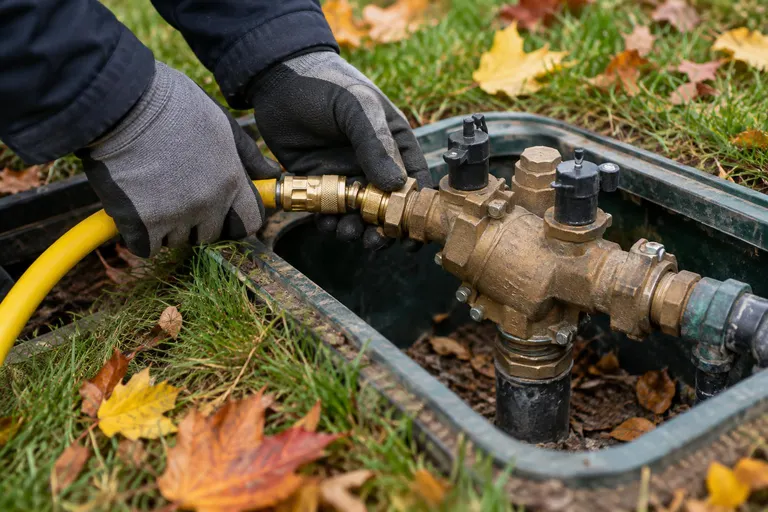
What it is, and why it matters.
Water expands when it freezes, and a frozen irrigation line can crack pipes, valves and backflow devices. The fix is simple: clear the water out before the first hard freeze with a compressor, then shut off and drain the system.
We shut off the water supply, connect an air compressor, blow out each zone in sequence, drain the backflow device, set the controller to rain or off mode and tell you what we found. A quick winterization costs far less than a spring repair.
Four things done right.
Zone by zone
Each zone is cleared in turn, not all at once.
Backflow protected
Exposed devices are drained and protected.
Controller set
The timer is put to rain or off mode.
Notes for spring
We flag anything that looks damaged.
From first call to sprinkler winterization.
- 1
Shut off water
The supply is closed and the system is depressurized.
- 2
Blow out each zone
Compressed air clears each line.
- 3
Drain and protect
Backflow and exposed parts are drained.
- 4
Set the controller
The timer is turned to rain or off.
Sprinkler Winterization in cities across the country.
We do this work for homes and businesses from coast to coast. Find your city to see the grass and climate we plan for.
Sprinkler Winterization: common questions
When should I winterize my sprinklers?
Before the first hard freeze, usually in late fall in cold climates.
Do I need to winterize if it rarely freezes?
In mild climates it may not be needed. We advise based on your region.
How do I get a quote for sprinkler winterization?
Fill in the form or call or text 800-224-9245. A few details about the lawn, or a photo, usually give us what we need, and we send a written price.
Ready to talk about sprinkler winterization?
A few details or a photo of the lawn, and a written price.